Headlines News :
Showing posts with label barack obama. Show all posts

Boehner accuses Obama of not having 'the guts' to cut spending


House Speaker John Boehner Tuesday repeatedly challenged the president's willingness to go against his own party on issues that include reforms to social programs and spending.

"I think he'd like to deal with it [fiscal problems], but to do the kind of heavy lifting that needs to be done, I don't think he's got the guts to do it,” the Ohio Republican said in a meeting with a small group of reporters for nearly an hour Tuesday morning. “He understands there is a spending problem. He understands that we need changes and reforms, and we need to solve these problems."

When pressed about the severity of that statement, he modified, saying the president does not have the "courage."Washington is in the midst of yet another fiscal crisis, facing a political showdown over so-called "sequestration," the self-imposed round of across-the-board spending cuts to domestic programs and the Pentagon. The sequester was supported by both the White House and Congress as a way to encourage lawmakers to find common ground. Instead, they have been mired in a stalemate, unable to find an equitable solution for both sides. 

"I am not suggesting that this is easy,” Boehner said, “but what I am suggesting is that he is the President of the United States. This is the biggest threat to our society."
President Obama campaigned on raising taxes on the wealthy and got that in the showdown over the fiscal cliff. He wants more revenue -- from what he says are "loopholes and deductions" for the wealthy. Republicans have balked at that notion, saying he already got all the revenue he was going to get.
The White House has accused Boehner of walking away from "grand bargains," deals to reduce the country's deficits, in both 2011 and 2012 because he could not sell it to his base. Boehner's office vehemently disagrees with that notion, instead pointing the finger back at the president.
Republicans also feel as if they have already given in and do not want to give more, particularly after passing the tax increase and punting on the debt ceiling, voting to suspend it temporarily until the Democratic-controlled Senate passes a budget, something it has not done in years.

But those maneuvers have not been without staunch GOP opposition and misfires. President Obama and Boehner were thought to be, once again, close to a deal when Boehner abruptly announced "Plan B," an initiative pushed by House leadership, including Majority Leader Eric Cantor (R-VA), that would have let tax cuts expire for millionaires. But Boehner pulled the measure after he realized it did not have majority support within his conference.
Instead, Boehner issued a statement urging President Obama and the Democratic-controlled Senate to pass something to avert the fiscal cliff. Boehner eventually brought the Senate-passed measure to the House floor. It passed without majority GOP support.
On immigration, Boehner claimed in the meeting, "The thing I am most concerned about immigration reform is the president getting in the way. Sometimes I think he'd rather have an issue than a solution. Here's the guy who four years ago said he was going to have immigration reform, and he's done absolutely nothing for four years. I hope the president will play a constructive role."
Democrats say that prior to the 2012 presidential election, they have faced a brick wall of opposition on immigration, despite President Obama's promises, especially from House Republicans. But since Obama's re-election, in which he won 71 percent of the Hispanic vote, Republicans have sounded a different tune on immigration.
Sen. Marco Rubio (R-FL), who will give the GOP response and is leading an immigration-reform effort in the Senate, dropped by the meeting as well.
"I didn't mean to interrupt--,” Rubio said, as he looked for a cup of coffee.
When asked if he is feeling any pressure tonight, big smile and said, "No."

Obama to release document on targeted killings to Congress


The Senate Intelligence Committee will receive a classified document Thursday that seeks to justify the administration's policy of targeting Americans overseas via drone attacks, chairwoman Dianne Feinstein said.
"I am pleased that the president has agreed to provide the Intelligence Committee with access to the OLC (Office of Legal Counsel) opinion regarding the use of lethal force in counterterrorism operations," the California Democrat said in a statement Wednesday.

"It is critical for the committee's oversight function to fully understand the legal basis for all intelligence and counterterrorism operations."
The announcement came shortly after an administration official said President Barack Obama had yielded to demands that he turn over to Congress the classified Justice Department legal advice that seeks to justify the policy."Today, as part of the president's ongoing commitment to consult with Congress on national security matters, the president directed the Department of Justice to provide the congressional Intelligence committees access to classified Office of Legal Counsel advice related to the subject of the Department of Justice White Paper," an administration official said Wednesday.

The 16-page white paper -- titled "Lawfulness of a Lethal Operation Directed Against a U.S. Citizen who is a Senior Operational Leader of Al Qaida or an Associated Force" -- is a policy paper rather than an official legal document.
The president, the official said, was turning over the information because he believes the scrutiny and debate is healthy.
The Senate Intelligence Committee is expected to receive the document the same day Obama's pick for CIA director, John Brennan, faces a confirmation hearing.
Brennan's hearing Thursday comes amid complaints from senators, including several Democrats, about secrecy surrounding the drone policy.
Amnesty International also weighed in on the debate, saying Congress should grill Brennan on his claim that the Obama administration's drone strikes are "conducted in full compliance with the law."
Iran says it has footage from downed U.S. drone
"Furthermore, Congress should immediately hold public hearings with independent experts to examine the administration's legal reasoning and ensure that the administration is following the 'rule book' for the use of lethal force that already exists: international human rights law and, in the very narrow circumstances to which it applies, international humanitarian law," the group said.

In a 2012 speech at the Woodrow Wilson International Center for Scholars in Washington, Brennan asserted that the drone strikes are legal under the Authorization for Use of Military Force resolution passed by Congress after the 9/11 attacks.
In addition, "There is nothing in international law that bans the use of remotely piloted aircraft for this purpose or that prohibits us from using lethal force against our enemies outside of an active battlefield, at least when the country involved consents or is unable or unwilling to take action against the threat," Brennan said at the time.
This does not appear to be the view of Ben Emmerson, United Nations special rapporteur on counterterrorism and human rights, who announced plans in October to investigate U.S. drone attacks and the extent to which they cause civilian casualties.
The drone campaign against al Qaeda and its allies has been one of Brennan's biggest legacies in the four years he was the president's principal adviser on terrorism.
According to a count by the public policy group New America Foundation, at least 28 of al Qaeda's leading members have been killed in drone strikes, including the U.S. citizen Anwar al-Awlaki, who played an operational role in al Qaeda in the Arabian Peninsula.
Al-Awlaki's teenage son died in a separate strike.
On Wednesday, the chairman of the House Intelligence Committee said the attack that killed al-Awlaki was justified.
"This is somebody who had said that he didn't want his U.S. citizenship anymore," Rep. Mike Rogers, R-Michigan, told MSNBC's "Andrea Mitchell Reports."
He said al-Awlaki had officially joined al Qaeda, and al Qaeda had declared war on the United States."
"The legal basis of this goes back many, many years when U.S. citizens would go and fight for foreign nations that were engaging in combat with the United States," Rogers said. "So what they were saying is, once you've made that choice, you no longer get the protections that you would. I mean, if you join the enemy overseas, you join the enemy overseas. And we're going to fight the enemy overseas."

In his speech at the Wilson Center, Brennan said drone strikes are "ethical" because of "the unprecedented ability of remotely piloted aircraft to precisely target a military objective while minimizing collateral damage; one could argue that never before has there been a weapon that allows us to distinguish more effectively between an al Qaeda terrorist and innocent civilians."

And Obama himself defended it in an appearance last October on "The Daily Show."
"There are times where there are bad folks somewhere on the other side of the world, and you've got to make a call and it's not optimal," he said. "And sometimes you've got to make some tough calls. But you can do so in a way that's consistent with international law and with American law."

Gay rights: How U.S. leads the way


Philippe Coste is the staff New York correspondent for the weekly L'Express. He also writes a blog on "lexpress.fr." His book, recently published in France, is about populism and the American justice system: "Quand la justice dérape" (When Justice goes off track).

A week before Barack Obama became the first U.S. president to mention gay rights in his inauguration speech, the French had already made history on that matter. Believe it or not, on January 13, there were half a million people on the streets of Paris, demonstrating against gay marriage.


The French Catholic church is supposed to be at its last gasp, but it seemed strong enough to mobilize parishes, religious school parents and the common conservative citizen against a project of "mariage pour tous" (marriage for everybody), that had long been part of the new Socialist President François Hollande's election platform. Now that the law is being debated in parliament, it will likely pass within a month, but the ruckus will have stripped it of provisions deemed essential to the gay community: the equal rights, even if they are married, to start a family and raise their children. It may also trigger off a new culture war.The Church would not have enjoyed that success alone, had it not found the most unexpected and efficient leader, in the person of Virginie Tellenne, alias "Frigide Barjot." The nom-de-scène of this enterprising entertainer, known for her long-time connection to the RPR, the party of Jacques Chirac, means "cookoo," and was a rallying cry for silly demonstrations, in the 80s, against cold weather in Paris, before she met God in 2004, and proclaimed herself "Jesus's PR person."I saw her recently on a French TV channel while, in her trademark miniskirt and fishnets, she was debating a lesbian activist named Caroline Fourest, who asked Barjot how she felt about "gathering hundred of thousand of people in a demonstration against the equal rights of another community." She answered that she "loved gays," reminding the audience she often "partied like crazy" at Bananas, a well known hangout of the hip Parisian LGBT crowd. Translation: gay was okay as long as it stayed in the "cage aux folles," in drag, in an entertaining margin, but certainly not in the mundane realities of everyday life, where it is way more complicated.Indeed. Frigide, just like a majority of the French, supported the civil union enacted in 1999, the so-called Pacs, designed mainly for same sex couples. It gives some rights, but doesn't legitimate partners as parents. Marriage would. And there is the rub: adoption, medically assisted procreation. "What about the bloodline? What about mother nature, and the right of kids raised that way to know their true origin?, shrieked Frigide, oblivious to the fact that children adopted or medically procreated with donated eggs by straight parents have the same problem. It all boiled down, at the minute of truth, to that question: "What about their right to be raised normally? she asked. By a mommy and a daddy?"Having witnessed the debate on same-sex marriage in the United States, that episode confirms one more difference between our cultures. Contrary to the Americans who, in spite of blunt evidence, still worship the act of marriage, with its fairy-tale rituals of proposing and funny kneeling, the French have a much more pessimistic, more realistic even, vision of the knot. But when it comes to families and raising kids, they seem to believe in the enchanted world of yore.In America, the same-sex unions were often seen as the sinful problem, as the Christian banners, "Adam and Eve, not Adam and Steve" proclaimed around the country. But children were nobody else's business for those willing to adopt, or procreate with the methods available to anyone able to pay for donated eggs, sperm or a surrogate mother.France is another story. In a country where unrealistic conditions slacken usual adoption, gay prospective parents have had to act as any straight single person would, ask for an adoption authorization, and, to improve the chances ... get the child in another country. The law debated these days may grant their partner equal parental rights for adoption. As for medically assisted procreation, it is another problem: As of today, it is simply forbidden unless the couple is heterosexual and married or able to prove they has lived together for at least two years. Surrogate mothers are prohibited in France, plain and simple.

Hollande himself, though he promotes gay marriage as a progressive symbol, admitted he doesn't personally favor allowing medically assisted reproduction to homosexuals, and with the assent of many socialist party officials, had these corresponding measures postponed -- for parliament to decide -- as another law to a future debate, in March.

One reason, besides the obvious fear of a culture war with the conservatives about sacred family values, maybe the fact that the government already pays four attempts of medically assisted procreation to heterosexual couples and doesn't wish to have to extend this costly favor to gays, nor, more importantly, does it want to change at any price the national moral doctrine.

Assisted reproduction is considered in France only as a way to treat the medical condition of infertility. Being gay is not an illness, neither is, for a woman, the fact that she has no man. As a consequence, French babies are born en masse from single and not-so-single mothers in nearby Belgium or Spain, where specialized services are legally available for a price. "These children already exist in France," concluded Caroline Fourest on the show."They were born from gay parents and they simply deserve to have it recognized."

Chuck Hagel grilled in Senate confirmation hearing


Defence Secretary nominee Chuck Hagel has sought to allay concerns that he is anti-Israel and soft on Iran, at a testy confirmation hearing.

The Senate armed services committee grilled Mr Hagel over his past remarks, with a fellow Republican labelling the nominee's record "deeply troubling".

The former Nebraska senator told the panel he could not be defined by any individual quote.

The hearing will lead to a final Senate vote on Mr Hagel's appointment.

Correspondents say he will probably be confirmed by the committee.

Although Democrats control the Senate, they may need Republican support to overcome procedural hurdles that could stop Mr Hagel's nomination.

Charm offensive

If confiAt Thursday's public hearing, Mr Hagel said he was "fully committed" to preventing Iran from obtaining a nuclear weapon, with "all options" on the table.

"I will ensure our friend and ally Israel maintains its qualitative military edge in the region," he added.

Mr Hagel also addressed criticism over a remark he made in a 2008 book that the "Jewish lobby" intimidates decision-makers on Capitol Hill.

"I've already said, I regret referencing the Jewish lobby," he told the hearing. "I should have said the pro-Israeli lobby."

Mr Hagel would be the only Republican in President Barack Obama's cabinet if the Senate confirms him to replace outgoing Defence Secretary Leon Panetta.

Before his hearing, he held one-on-one meetings with 53 senators.

But only one Republican senator, Thad Cochran of Mississippi, has publicly backed him.

Once the hearing was under way, the Republican National Committee sent a news release saying Mr Hagel was the wrong choice to lead the Pentagon.

At least three Republicans on the Senate armed services committee have said they do not support his nomination.

Heated exchange
One of those is Senator Jim Inhofe, the top Republican on the panel, who said shortly after the hearing began: "Senator Hagel's record is deeply troubling and out of the mainstream."

There was also a heated exchange between John McCain and the Pentagon nominee.

The Arizona senator took his fellow veteran to task over remarks he made once that the 2006 Iraq troop surge would be "the most dangerous foreign policy blunder in this country since Vietnam".But Democratic Senator Carl Levin, chairman of the committee, said his concerns had been allayed.

"Senator Hagel's reassurance to me," Sen Levin said, "that he supports the Obama administration's strong stance against Iran is significant."

The hearing is the first time Mr Hagel has publicly addressed the criticism against him.

In the past, he has opposed the idea of a military strike by either the US or Israel against Iran. He has also advocated including Iran on future peace talks in Afghanistan.

His remarks in 1998 that a nominee for an ambassadorial post was "openly, aggressively gay" also raised eyebrows. Mr Hagel has since apologised for that comment.rmed, he would be the first enlisted man - and the first Vietnam veteran - to run the Pentagon.

Obama Immigration Plan: More Direct Path to Citizenship Than Senate's


Obama Immigration Plan: More Direct Path to Citizenship Than Senate's


President Barack Obama is expected to lay out his principles for immigration reform in a speech in Las Vegas today that will include a potentially quicker path to citizenship than the bipartisan plan a group of senators unveiled earlier this week. 

The president will offer some new details about the White House's immigration reform plan, which expands on a blueprint it released in 2011, a senior administration official told ABC News. But for now Obama will stop short of offering his own piece of legislation because of the progress made by the Senate "Gang of Eight."
 
The White House has sounded positive notes about the Senate group's plan thus far, but the specifics that Obama announces are expected to have some key differences that might cause concern for some Republican senators who have signed onto the senate deal. 

Like the senators' plan, Obama's proposal calls for a pathway to citizenship for many of the 11 million undocumented immigrants living in the U.S. The senators' plan would grant "probationary legal status" immediately to eligible undocumented immigrants, but would not allow them to apply for permanent legal status, or a green card, until the border is deemed to be secure. Think of that as a trigger system. 

On the other hand, administration officials told media outlets that they believe a path to citizenship needs to be more straightforward. They believe a trigger system, like the one in the senate plan, could lead to a state of legal limbo for the undocumented immigrants who receive legal status, The Washington Post reported. 


The border-security-first plan, however, is essential to Republican senators who signed onto the Senate "Gang of Eight" deal. 

"I will not be supporting any law that does not ensure that the enforcement things happen," Sen. Marco Rubio (R-Fla.), a member of the group, told conservative blogger Ed Morrissey on his web radio show. 

Obama's plan is likely to include language that would allow same-sex bi-national couples to have the same rights as heterosexual couples, BuzzFeed and The Washington Post reported. Under current law, gays and lesbians who are married to U.S. citizens under state laws cannot obtain a green card. Obama's plan would allow them a path to citizenship, but the issue is not mentioned in the Senate "Gang of Eight" proposal. 

As noted by the Post, that language may anger Christian groups who have signaled they would support comprehensive immigration reform. 

But the White House remains optimistic about the progress that has been made so far. An official described the senators' announcement as a "breakthrough" to ABC News because it wasn't clear whether Republicans would sign on to any path to citizenship. 

Some observers couched the Senate group's decision to come out with his plan a day before Obama as an attempt to outfox the White House politically. But administration officials told media outlets they remain generally pleased with the plan and believe that the president's speech could build momentum for a final bill.

The White House reiterated that the president was very encouraged by the Senate's proposal since it includes a pathway to citizenship that is endorsed by Republicans, who have previously opposed immigration reform that includes such a path. 

"Our focus is that this is a positive development," White House spokesman Luis Miranda told ABC/Univision. "We feel very positive that there is a proposal in the first place and that it is consistent with what the president has supported in the past." 

The White House clarified that it is withholding judgment on language in the Senate framework that requires a border security "trigger" to obtain a green card until actual legislative language is released by the senators.
"What we have said is that there needs to be a clear path to citizenship," said Miranda. "We'll wait to see what they flesh out."

Senators reach deal on immigration changes


A bipartisan group of leading senators has reached agreement on the principles of sweeping legislation to rewrite the nation's immigration laws.

The deal, which was to be announced at a news conference Monday afternoon, covers border security, guest workers and employer verification, as well as a path to citizenship for the 11 million illegal immigrants already in this country.

Although thorny details remain to be negotiated and success is far from certain, the development heralds the start of what could be the most significant effort in years toward overhauling the nation's inefficient patchwork of immigration laws.

President Barack Obama also is committed to enacting comprehensive immigration legislation and will travel to Nevada on Tuesday to lay out his vision, which is expected to overlap in important ways with the Senate effort.

The eight senators expected to endorse the new principles Monday are Democrats Charles Schumer of New York, Dick Durbin of Illinois, Robert Menendez of New Jersey and Michael Bennet of Colorado; and Republicans John McCain of Arizona, Lindsey Graham of South Carolina, Marco Rubio of Florida and Jeff Flake of Arizona.

Several of these lawmakers have worked for years on the issue. McCain collaborated with the late Democratic Sen. Edward M. Kennedy on comprehensive immigration legislation pushed by then-President George W. Bush in 2007, only to see it collapse in the Senate when it couldn't get enough GOP support.

Now, with some Republicans chastened by the November elections which demonstrated the importance of Latino voters and their increasing commitment to Democrats, some in the GOP say this time will be different.

"What's changed, honestly, is that there is a new, I think, appreciation on both sides of the aisle — including maybe more importantly on the Republican side of the aisle — that we have to enact a comprehensive immigration reform bill," McCain said Sunday on ABC's "This Week."

"I think the time is right," McCain said.

The group claims a notable newcomer in Rubio, a potential 2016 presidential candidate whose conservative bona fides may help smooth the way for support among conservatives wary of anything that smacks of amnesty. In an opinion piece published Sunday in the Las Vegas Review-Journal, Rubio wrote that the existing system amounts to "de facto amnesty," and he called for "commonsense reform."

According to documents obtained by The Associated Press, the senators will call for accomplishing four goals:

    Creating a path to citizenship for illegal immigrants already here, contingent upon securing the border and better tracking of people here on visas.
    Reforming the legal immigration system, including awarding green cards to immigrants who obtain advanced degrees in science, math, technology or engineering from an American university.
    Creating an effective employment verification system to ensure that employers do not hire illegal immigrants.
    Allowing more low-skill workers into the country and allowing employers to hire immigrants if they can demonstrate they couldn't recruit a U.S. citizen; and establishing an agricultural worker program.

The principles being released Monday are outlined on just over four pages, leaving plenty of details left to fill in. What the senators do call for is similar to Obama's goals and some past efforts by Democrats and Republicans, since there's wide agreement in identifying problems with the current immigration system. The most difficult disagreement is likely to arise over how to accomplish the path to citizenship.

In order to satisfy the concerns of Rubio and other Republicans, the senators are calling for the completion of steps on border security and oversight of those here on visas before taking major steps forward on the path to citizenship.

Even then, those here illegally would have to qualify for a "probationary legal status" that would allow them to live and work here — but not qualify for federal benefits — before being able to apply for permanent residency. Once they are allowed to apply they would do so behind everyone else already in line for a green card within the current immigration system.

That could be a highly cumbersome process, but how to make it more workable is being left to future negotiations. The senators envision a more streamlined process toward citizenship for immigrants brought here as children by their parents, and for agricultural workers.

The debate will play out at the start of Obama's second term, as he aims to spend the political capital afforded him by his re-election victory on an issue that has eluded past presidents and stymied him during his first term despite his promises to the Latino community to act.

"As the president has made clear for some time, immigration reform is an important priority and he is pleased that progress is being made with bipartisan support," a White House spokesman, Clark Stevens, said in a statement. "At the same time, he will not be satisfied until there is meaningful reform and he will continue to urge Congress to act until that is achieved."

For Republicans, the November elections were a stark schooling on the importance of Latino voters, who voted for Obama over Republican Mitt Romney 71 percent to 27 percent, helping ensure Obama's victory. That led some Republican leaders to conclude that supporting immigration reform with a path to citizenship has become a political imperative.

John Kerry eyes revival of Middle East peace talks


US Senator John Kerry has warned that a failure of a two-state solution in the Middle East would be "disastrous", at his confirmation hearing as secretary of state.

But Sen Kerry said he believes there is a "way forward" on peace talks between Israel and the Palestinians.

US-brokered peace talks in the Middle East broke down in 2010.

Sen Kerry sailed through his hearing to replace Hillary Clinton at the helm of the state department.

A Vietnam veteran and a senator since 1985, he was the Democratic presidential nominee in 2004, losing the election to George W Bush.

'Disastrous'
He is chairman of the Senate foreign relations committee, which conducted Thursday's hearing. It was led instead by Senator Robert Menendez of New Jersey.Sen Kerry warned "the window or door on a two-state solution could shut - and that would be disastrous for all concerned".

"Perhaps this can be a moment where we can renew some kind of effort to get the parties into a discussion to have a different track than we have been on over the last couple of years," he said, adding that it was unclear what government would emerge from Israel's recent election.

The Massachusetts senator did not give details of possible plan, saying he did not want to prejudice any new effort.

During the five-hour hearing, Sen Kerry also said "we will do what we must to prevent Iran from obtaining a nuclear weapon".

"I repeat here today: our policy is not containment. It is prevention and the clock is ticking on our efforts to secure responsible compliance," he told the panel.

He said he hoped the US and its allies would maintain diplomatic pressure against Iran, but said Iran had to prove its nuclear programme was solely for peaceful purposes.

Sen Kerry also spoke about American efforts to strengthen its relationship with China, saying it would be "a tough slog". And he described himself as a "passionate advocate" on battling global warming.

'The right choice'
He was introduced by Mrs Clinton, Republican Senator John McCain and Massachusetts Senator Elizabeth Warren.

"John is the right choice," Mrs Clinton said of her designated successor. "He will bring a record of leadership and service that is exemplary."

Her recommendation was immediately echoed by Sen McCain.

"Witnessing almost daily his exemplary statesmanship is one of the highest privileges I've had here," he said.

Sen Kerry's nomination as secretary of state opens his Massachusetts Senate seat.

The place will temporarily be filled by appointment by Democratic Massachusetts Governor Deval Patrick. A special election will follow within months.

Sen Kerry was Mr Obama's second choice, after UN Ambassador Susan Rice became embroiled in controversy over last September's raid on a US consulate in Benghazi, Libya.

Republican senators accused her of deliberately misleading the American people over the nature of the attack, which left four Americans dead.

The Obama administration angrily rejected the claims, but Ms Rice withdrew her name from consideration for secretary of state.

North Korea says a new nuclear test will be part of fight against U.S.

new nuclear test will be part of fight against U.S.

North Korea says a new nuclear test will be part of fight against U.S.

North Korea said Thursday that it plans to carry out a new nuclear test and further long-range rocket launches, all of which it said are a part of a new phase of confrontation with the United States.

The North's National Defense Commission said the moves would feed into an "upcoming all-out action" that would target the United States, "the sworn enemy of the Korean people."

Carried by the state-run Korean Central News Agency, the defense commission statement followed a United Nations Security Council resolution on Tuesday that condemned North Korea's recent rocket launch and expanded existing sanctions.

North Korea, which often issues bellicose statements in its state media, said Thursday that it rejected all Security Council resolutions concerning it.

It described this week's resolution as "the most dangerous phase of the hostile policy toward the DPRK," using the abbreviated version of its official name, the Democratic People's Republic of Korea.

Just before the North sent out its hostile statement, a U.S. State Department official was telling reporters in Seoul that Washington hoped that Pyongyang wouldn't carry out another nuclear test.

"It would be a mistake and a missed opportunity if they were to do it," said Glyn Davies, the U.S. special envoy on North Korea. "This is not a moment to increase tension on the Korean peninsula."
North Korea has carried out two previous nuclear tests, in 2006 and 2009.

Don't expect an Obama-Netanyahu blowup


Washington-- In the run-up to the Israel elections, two pieces of conventional wisdom were making the rounds among analysts, diplomats and experts: First, Benjamin Netanyahu would win big, and second, the victory would propel him on a collision course with Barack Obama, a second term president seeking to do something serious on the peace issue.

The first proved to be dead wrong. The second will probably follow suit."Bibi" Netanyahu has just been re-elected prime minister, no less for the third time. But don't get out the popcorn and turn out the lights just yet. The sequel to the Obama-Bibi wars isn't about to begin.

Sure, their relationship has been perhaps the most dysfunctional in the history of U.S.-Israeli ties. And there are bound to be plenty of downs in the next several years, particularly if Netanyahu is forced to form a narrow right-wing governing coalition.But the U.S.-Israeli relationship is simply too big and important to fail, particularly now.
Netanyahu's party wins but centrists flex muscle, polls show
Indeed, given the real prospects that the new Israeli coalition will include Yair Lapid's centrist party (whose surprise showing of 19 seats may make him a coalition lynchpin) and maybe another moderate faction if Lapid won't sit with other right-wingers in the coalition, the two leaders may have less reason to fight and more reasons to cooperate. Here's why.
Second term illusion
The notion that a second-term president freed from the constraints of re-election will now hammer an Israeli prime minister with a big peace initiative just doesn't add up.
First, there's no precedent for such a thing in American policy toward the Arab-Israeli negotiations. Bill Clinton's push at Camp David in July 2000 -- the precedent most often cited -- came not from Clinton, but at then-Prime Minister Ehud Barak's urging.Second, it's the presence of opportunity, not the absence of political constraints or the desire to get even and settle scores, that leads a U.S. president to act.
A quick look around and any sentient human being would see that a grand deal between Israelis and Palestinians isn't possible now. Lapid's presence in the coalition may restrain some of the Israeli right's ambitions to expand settlements, but it isn't enough to support a full-scale push toward a comprehensive peace.
Indeed. Lapid's focus was on economic issues and national service, not on negotiations with the Palestinians.
The suspicions between Israelis and Palestinians are too deep, the gaps on the issues too big, and the political houses on each side too divided.
More likely, the new Netanyahu government will focus on some kind of interim accord with the Palestinians. And that leads us to the second reason that a big fight is likely not in the offing.
Why fight about nothing?
Fighting with an Israeli prime minister (and the Arabs, too) is a part of the job description of serious American mediators. But the fight needs to be productive and worth the effort.
Right now, there's nothing to fight about because there's no conceivable Israeli-Palestinian agreement in the offing. You fight when you think there's a way to produce an agreement that would justify the risks of a confrontation, not when you're certain to fail. For Obama, whose domestic agenda will require an enormous expenditure of political capital at home, neither fighting with Republicans and Democrats over pressure on Israel nor launching an initiative that fails is smart politics.
John Kerry needs a friend
We are going to have a new secretary of state who will have responsibility -- assuming he can convince the president to let him handle the issue -- for dealing with the Israeli-Palestinian problem. The last thing Kerry wants is a worsening of ties between Obama and Netanyahu that makes it impossible for him to do his job on such a key issue.
If Kerry wants to have a chance of succeeding -- even to manage the problem -- he'll need a relationship with Netanyahu based on some measure of confidence and trust. This is even more important given the absence of such trust between Obama and the prime minister.
Bush 41 and then-Prime Minister Yitzhak Shamir didn't get along. James Baker managed to hammer out a working relationship with Shamir, tense at times but functional. Without it, there would have been no Madrid peace talks.
If Kerry is smart, he'll keep the door to Netanyahu open and try to see if he can't reach some understanding with the prime minister. If he can't, there will be plenty of time to fight later.
The Iranian Issue
The big reason why Bibi and Obama will likely have a stake this time around in more cooperation and less friction is Iran. The fact is neither Obama, the mullahs, nor Netanyahu wants a war over the nuclear issue. But avoiding one will require the closest of cooperation between Jerusalem and Washington.
There's an expectation that 2013 will be the year of decision on the Iranian nuclear issue. Maybe yes, maybe no. But that expectation alone will require intimate coordination to prevent a unilateral Israeli strike, to see whether diplomacy can produce an Iranian-American deal and to determine whether it can be sold to Israel.
If not, and no diplomatic fix to the nuclear issue is possible, American-Israeli understandings will be required on a military option. Either way, neither the United States nor Israel can avoid a public falling out over Iran or a major split over how to manage the problem.
Simply put, the U.S.-Israeli relationship is too big to fail. That doesn't mean there won't be real differences over settlements, for example, that won't cause friction.
But on the two biggest issues of the day, how to manage Iran and the Palestinians, there can't be solutions without close Israeli-American cooperation.
It's legacy time. This is Obama's last term as president and perhaps Netanyahu's last term as prime minister. Obama doesn't want to be the U.S. president on whose watch Iran crossed the nuclear weapons threshold and certainly neither does Bibi want to be the Israeli prime minister held responsible.
It would be nice to imagine that the two can sit down and reach a broad strategic understanding -- first we deal with Iran, and if we succeed through diplomacy or even war, then let's find a way to preserve the two-state option for Israel and the Palestinians.
But even if this doesn't happen, these two leaders are inexorably bound together. They're never going to love each other. But I'm betting they'll find a way to get by without a major fight neither wants. The fact is the protection of Israeli and American interests and regional stability in a volatile, turbulent Middle East depends on it.


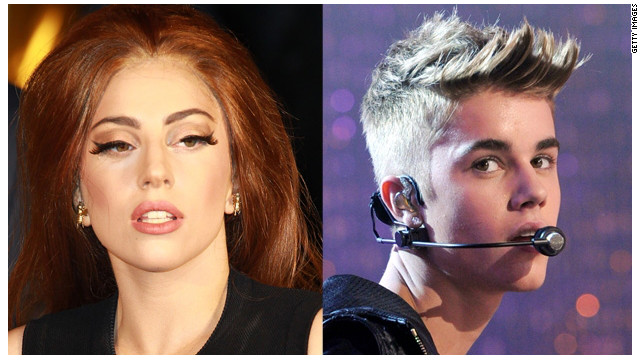
Justin Bieber dethrones Lady Gaga on Twitter


Justin Bieber dethrones Lady Gaga on Twitter

In a perfect world, our most popular Twitterer might be a brilliant scientist, writer, philosopher or spiritual leader. In this world, he is an 18-year-old pop star with famous hair.

On Monday night, Justin Bieber surpassed fellow singer Lady Gaga to become the most-followed person on Twitter.

 As of Tuesday morning, The Biebs had more than 33,333,000 followers, while Gaga was closing in on 33,329,000. Both numbers continued to creep up, but it appeared Bieber was gradually increasing his lead.

Neither had immediately acknowledged the milestone on Twitter. Gaga's latest tweet was a message to fans about her concert Monday night in Hollywood, California, while Bieber's was a plug for a recent Teen Vogue photo shoot.

 Based on their respective rates of growth, Bieber and his hordes of Beliebers were projected to overtake Gaga on Sunday afternoon, according to Twitter Counter, but Gaga's Little Monsters put up a fight.

The coiffed Canadian crooner is Twitter's first new king or queen since Gaga dethroned Britney Spears in August 2010. But Gaga still has more fans on Facebook -- almost 55 million, compared to Bieber's 50,666,000. (Rihanna tops both with 65 million.)

 Twitter's top 10 users (seven of them are singers):
1. Justin Bieber -- 33.333 million
2. Lady Gaga -- 33.329 million
3. Katy Perry -- 31.4 million
4. Rihanna -- 27.9 million
5. Barack Obama -- 26.1 million
6. Britney Spears -- 23.3 million
7. Taylor Swift -- 23.1 million
8. YouTube -- 22.2 million
9. Shakira -- 19.3 million
10. Kim Kardashian -- 17.2 million

Obama finally meets Machiavelli


U.S. President Barack Obama and first lady Michelle Obama attend the Commander-in-Chief's Ball, honoring U.S. service members and their families, at the Walter E. Washington Convention Center on Monday, January 21, in Washington after Obama's second Inauguration as the 44th U.S. president.

It's a good bet that millions of Americans on Monday greeted President Barack Obama's magnificent second inaugural address not just with applause and cheers of approval but with loud sighs of relief.

Gone were his first inaugural speech's bizarre equal division of blame for the wreckage of real lives between the "greed of some" and the so-called "collective failure" of the rest of us. Instead, Obama rang out his commitment to equality for all, not the "shrinking few and lucky" who call the rest of us simply "takers."
Nor did our president chide us to put away ''childish things" by seeming to describe deep differences over "perpetual war," climate change, immigration, equal rights, voting rights, rights to decent wages for honest labor and rights to "basic measures of security and dignity" as "petty grievances."This time around, Obama offered us not song and dance morals from an old Depression musical comedy to "pick ourselves up, dust ourselves off and start all over again," but solid, specific support for the serious New Deal pillars of Social Security and Medicare.Almost for the first time as president, he dared to utter the word "poverty" in a major address, and declared ''we must be a source of hope to the poor, the sick, the marginalized, the victims of prejudice."
These moments and more earned his speech the warm response and respect it deserves. Now it will receive the careful analysis it cannot escape. This will reveal even more profound differences between Obama's second inaugural speech and his historic appearance on the steps of the U.S. Capitol as the president of color few believed they would see elected in their lifetimes
.
1. His first inaugural address was a puzzling disappointment after the passionate convictions he expressed so powerfully in both his primary and general election campaigns. Some suggested that his finest moment was Election Night in Chicago's Grant Park. No one who followed his campaign, including his opponents, could have been surprised by his second inaugural speech.

2. Monday's words were those of a leader who has chosen to fight for the change he believes in over flailing attempts to placate that only produced astounding charges that he was unwilling to compromise when in fact he had given so much in doomed efforts to do just that.

3. His repeated calls for "We the People" to work together were not-so-subtle warnings of who would be responsible if the U.S. government is unable to do so. No blame-splitting this time.

4. Even Obama's delivery and demeanor conveyed conviction, not the sense that a press aide might soon emerge from Caesar's tent beside the Rubicon to explain that his thinking is still "evolving."In this second inaugural address, Obama the Candidate became Obama the President without a trace of the bait and switch to which too many citizens have become so accustomed that in their cynicism they cease to vote at all. He spoke as a leader who has stopped splitting differences and is prepared to make choices and fight for them -- together as We the People if possible, alone as Obama the President if not.

Opinion: Obama's America, better than what Founders imagined
In fact, Monday's speech felt as if after four frustrating years of trying to appease his opponents, Barack Obama had finally met Machiavelli one night in the Lincoln Bedroom and learned that when faced with two equally powerful opposing forces, a president must choose, or both will attack him. He sounded like a leader who knows now that the difference between making a choice and making love is that decisions don't feel better the longer you can draw them out.
As Obama goes from celebration to celebration, his supporters and his opponents have a much clearer idea of what he will do tomorrow, and for the next 1,000-plus days he is president.
This time when he tells banks and insurance companies that "a free market only thrives when there are rules to ensure competition and fair play," they will do well to believe him. Because even with all the cash he collected to fill the coffers of his campaign, Monday's speech makes it clear he will not let it line the coffin of his presidency.
It betrays no security measures to mention that the Secret Service chooses oddly accurate code words for the presidents it protects.
After Obama's first inauguration, that could have been "dancer." After Monday's address, it could legitimately consider ''leader." If the president is able to act in accordance with his second inaugural address, it's not impossible now to imagine "Lincoln." He wasn't afraid to fight when the nation would not stay together.

Obama embraces progressive agenda in second inaugural address

President Barack Obama Inaugural

Obama embraces progressive agenda in second inaugural address

President Barack Obama delivered a forceful defense of the nation's safety net programs, and vowed to expand gay rights and tackle the problem of climate change in his second inaugural address Monday afternoon.

The speech was a bolder and more specific defense of the president's liberal governing vision than the address he gave four years ago. For his first inaugural address, Obama stuck to a broader outline of his ideals and called on politicians to overcome partisan differences and work together in the face of economic crisis.

On national television and before a crowd of hundreds of thousands of spectators who descended on the Mall, Obama staunchly reiterated his belief that gay people should be allowed to marry.
"Our journey is not complete until our gay brothers and sisters are treated like anyone else under the law–-for if we are truly created equal, then surely the love we commit to one another must be equal as well," Obama said. He also mentioned the gay rights Stonewall Riots of the 1960s in the same breath as the Selma civil rights marches.

In the same section of the speech, the president made oblique references to gun violence, equal pay for women and immigration reform. He called for "all our children, from the streets of Detroit to the hills of Appalachia to the quiet lanes of Newtown" to be kept safe from harm.
Earlier in the speech, Obama said to avoid the problem of climate change would "betray our children and future generations," signaling he may also make that issue a key piece of his second-term agenda. He abandoned efforts during his first term to push for so-called "cap and trade" legislation to curb greenhouse gas emissions.

The president challenged critics who have argued that the government must reduce its spending and cut back on social welfare programs, including Obama's health care reform law. Obama said that the country must reduce its deficit, but that the nation must work to protect equality of opportunity, in what seemed to be a reference to his battles with congressional Republicans over taxing and spending.
"We are true to our creed when a little girl born into the bleakest poverty knows that she has the same chance to succeed as anybody else, because she is an American, she is free, and she is equal, not just in the eyes of God but also in our own," he said.

Obama argued that the nation's entitlement programs make America stronger because they protect this chance at equality. "We recognize that no matter how responsibly we live our lives, any one of us, at any time, may face a job loss, or a sudden illness, or a home swept away in a terrible storm," Obama said. "The commitments we make to each other–-through Medicare, and Medicaid, and Social Security--these things do not sap our initiative; they strengthen us. They do not make us a nation of takers; they free us to take the risks that make this country great."

The president also warned in the 2,095-word speech that the country cannot succeed if a "shrinking few" succeed economically while the middle class suffers.

Joe Biden sworn in as vice-president for second term

Joe Biden

 Joe Biden was sworn in as vice-president for a second term early Sunday, ushering in the formal proceedings on inauguration weekend. Barack Obama was scheduled to take the oath at midday.

Biden chose Supreme Court justice Sonia Sotomayor to administer the oath, the first Latino to do so and the fourth woman. Obama's oath will be administered by Chief Justice John Roberts, who mangled the oath in 2009, requiring the ceremony to be done over.

The two events mark the formal part of a series of events that began on Saturday and will stretch into Tuesday. Under the constitution, the two had to be sworn in on 20 January. But because that date falls on a Sunday, the public event will be held on Monday, when Obama and Biden will take the oath again and Obama will deliver his inauguration speech from outside Congress.

If the election in November had gone the other way, it would have been congressman Paul Ryan taking the oath, with Mitt Romney reading to formally become president at midday.

Biden was sworn in by Sotomayor at his residence in the Naval Observatory, about 15 minutes' drive from the White House. Biden celebrated mass before taking the oath on a bible that has been in his family since the end of the 19th century. He was surrounded by 120 members of his family, friends and staff and members of Congress.

Shortly after Biden's ceremony, he received the congratulations of president, via a tweet.

Between Biden's and Obama's swearing in ceremonies on Sunday, the two visited together Arlington cemetery to lay a wreath. After the swearing-in ceremony on Monday, there will be an inaugural parade from Congress to the White House and in evening, inaugural balls.

Four years, two faces, one smile: Barack Obama

Four years, two faces, one smile: Barack Obama
Barack Obama
Are happy days here again? It sure looks that way from the new official portrait of President Obama released by the White House on Friday.

The new color photo shows the President standing tall, flashing a big smile, his arms folded, flanked by flags and standing in front of his desk in the Oval Office.

It’s a markedly different image of Obama than the official portrait taken four years ago, after he won his first historic election.

In the 2008 photo the President looked somewhat somber. The setting was bland and unrecognizable, with flags over his right shoulder. Of course, the first photo was taken as the nation was rocked by a recession and mired in two wars, and Osama Bin Laden was on the loose.

Today, the U.S. is out of Iraq and the economy is back on its feet, if not quite standing tall. Perhaps the President feels he has something to smile about. The new photo, however, reflects a change that, in private moments, might not make the President so happy. It shows his hair now flecked with gray.
White House photographer Pete Souza took the new photo on Dec. 6 with a digital camera. It will replace the 2008 photo in all federal office buildings, including all U.S. embassies around the world. The new portrait received mostly positive reviews Friday.

“The first Obama presidential portrait was, well, kind of lame. Somber, yes, but not exactly confidence inspiring,” John Avlon wrote in The Daily Beast.

“Part of the trick of presidential leadership is projecting optimism and strength — something iconic presidents like Reagan and FDR well understood. Which is why President Reagan was offering a broad grin in his official portrait at the height of the Cold War.”

Jezebel.com said the new image reflects a switch “from business to business-casual.”

“Things have changed. The President has been reelected and can now relax a little bit and party it up with a big toothy smile.”

nydailynews.com

Beyonce, Katy Perry to perform at star-studded inauguration


President Barack Obama's inauguration is shaping up to be an event as star-studded as any red carpet, with performances from heavy-hitters like Beyonce, Katy Perry, Kelly Clarkson, Stevie Wonder, Alicia Keys, Usher and Brad Paisley.

Beyonce will sing the national anthem and James Taylor will sing "America the Beautiful" on the West Front of the Capitol on Monday in Washington. Clarkson will sing "My Country 'Tis of Thee." Planners of the event said the president personally selected the performers.

Pop-rock trio fun., who had a wild year with two No. 1 hits, a near-platinum album and six Grammy nominations, will perform for first lady Michelle Obama, Sasha and Malia and Jill Biden on Saturday at the Kids' Inaugural Ball."It's been amazing year, and 2013 is kicking off with us doing the inauguration ... it's just an incredible thing," said lead singer Nate Ruess. "I think the three of us care so much about Obama and so to be invited, I can't even deal."

The band will be joined at the concert by Perry, Wonder, Keys, Usher, Smokey Robinson, Paisley, Marc Anthony, Mindless Behavior, Nick Cannon and the cast of "Glee."

"I think they're all very talented people. Stevie's my brother and so is Usher," Robinson said in an interview. "I know Katy...I'm very happy to be performing among them."

While there will be no shortage of star power, it's not quite a repeat of the 2009 inauguration when everyone who's anyone flocked to Washington for a televised concert on the Mall.

The first time around, Beyonce was a surprise guest, singing the Etta James classic "At Last" for the Obamas' first dance. Her husband, Jay-Z, was another surprise at the private staff ball, singing "99 Problems but George Bush Ain't One." The Jonas Brothers -- then favorites of the Obama girls -- performed at the kids' concert and U2, Springsteen and so many others performed on the Mall.

There may still be surprises in store, but plenty of performances are assured. Keys, Paisley, Chris Cornell, Jamie Foxx, Jennifer Hudson and Anthony will perform at the Commander-in-Chief's Ball on Monday.

Will.i.am, who debuted the song "New Day" at 2009's inauguration, will be at a number of events, including OurTime.org's "General Now Party" on Saturday, which also includes John Legend, Jessica Alba, Common and Flo Rida. Eva Longoria will host the "In Performance at the Kennedy Center" event, which celebrates Latino arts and culture, and will feature Antonio Banderas and Rosario Dawson. And 25-year-old pop party girl Ke$ha will perform a charity concert Monday.

The Creative Coalition will host parties Sunday and Monday that is expected to include Eric Stonestreet, Connie Britton, Taraji P. Henson, Melissa Leo and David Arquette, among others.

Like will.i.am, soul crooner Legend will attend multiple events, including Russell Simmons' Hip-Hop Inaugural Ball II with 2 Chainz, Brandy and Pharrell. BET also has a ball that comedian-actor Wayne Brady will host; performers include Bell Biv Devoe, Doug E. Fresh, MC Lyte and Jermaine Dupri. And Pharrell will host an event late Monday that supports education.

Clarkson says she continues to gush when she thinks about all that's going on to celebrate Obama's second term in office.

"I'm excited to be a part of it honestly. I'm more stoked about (it more) than maybe a lot in my career," she said.

‘No silver bullet’ against gun violence


Vice President Joe Biden said on Friday he was “shooting for Tuesday” to get President Barack Obama his recommendations on how to battle an epidemic of gun violence and warned “there’s no silver bullet” to stop the killing.

Biden was meeting in the Eisenhower Executive Office Building adjacent to the White House with executives from video game companies whose products have often been blamed for making players insensitive to real-world violence.

"I come to this meeting with no judgment. You all know the judgment other people have made," Biden said. (He did not elaborate, but one attendee brought a copy of the book “Grand Theft Childhood: The Surprising Truth About Violent Video Games.” A summary is here.)

The vice president has been meeting with government officials, gun-violence victims and their advocates, retailers, Hollywood executives and groups like the National Rifle Association that advocate gun rights.
He said earlier this week that he hoped to get his report—commissioned in the aftermath of the elementary school slaughter in Newtown, Conn.—to Obama on Tuesday. His advice is expected to reinforce Obama's calls for Congress to renew the assault weapons ban, toughen background checks and impose new restrictions on purchases of high-capacity ammunition magazines.

"I'm shooting for Tuesday. I hope I get it done by then,” he said on Friday, cautioning that "we know that there's no silver bullet."

Biden asked whether a “coarsening of our culture” might be partly to blame, but added: "I do not know the answer to that question."

The vice president, Attorney General Eric Holder and Health and Human Services Secretary Kathleen Sebelius represented the administration in this week's meetings. The video game industry was represented by officials from such brand-name software companies as Activision Blizzard and Electronic Arts, and retailers like GameStop. There were also researchers from the University of Wisconsin-Madison and Texas A&M University.

US may leave no troops in Afghanistan beyond 2014


US may leave no troops in Afghanistan beyond 2014

WASHINGTON (AP) — The Obama administration says it might leave no troops in Afghanistan after December 2014, an option that defies the Pentagon's view that thousands of troops may be needed to contain al-Qaida and to strengthen Afghan forces.

"We wouldn't rule out any option," including zero troops, Ben Rhodes, a White House deputy national security adviser, said Tuesday.

"The U.S. does not have an inherent objective of 'X' number of troops in Afghanistan," Rhodes said. "We have an objective of making sure there is no safe haven for al-Qaida in Afghanistan and making sure that the Afghan government has a security force that is sufficient to ensure the stability of the Afghan government."

The U.S. now has 66,000 troops in Afghanistan, down from a peak of about 100,000 as recently as 2010. The U.S. and its NATO allies agreed in November 2010 that they would withdraw all their combat troops by the end of 2014, but they have yet to decide what future missions will be necessary and how many troops they would require.

At stake is the risk of Afghanistan's collapse and a return to the chaos of the 1990s that enabled the Taliban to seize power and provide a haven for Osama bin Laden's al-Qaida network. Fewer than 100 al-Qaida fighters are believed to remain in Afghanistan, although a larger number are just across the border in Pakistani sanctuaries.

Defense Secretary Leon Panetta has said he foresees a need for a U.S. counterterrorism force in Afghanistan beyond 2014, plus a contingent to train Afghan forces. He is believed to favor an option that would keep about 9,000 troops in the country.

Administration officials in recent days have said they are considering a range of options for a residual U.S. troop presence of as few as 3,000 and as many as 15,000, with the number linked to a specific set of military-related missions like hunting down terrorists.

Asked in a conference call with reporters whether zero was now an option, Rhodes said, "That would be an option we would consider."

His statement could be interpreted as part of an administration negotiating strategy. On Friday Afghan President Hamid Karzai is scheduled to meet President Barack Obama at the White House to discuss ways of framing an enduring partnership beyond 2014.


The two are at odds on numerous issues, including a U.S. demand that any American troops who would remain in Afghanistan after the combat mission ends be granted immunity from prosecution under Afghan law. Karzai has resisted, while emphasizing his need for large-scale U.S. support to maintain an effective security force after 2014.

In announcing last month in Kabul that he had accepted Obama's invitation to visit this week, Karzai made plain his objectives.

"Give us a good army, a good air force and a capability to project Afghan interests in the region," Karzai said, and he would gladly reciprocate by easing the path to legal immunity for U.S. troops.

Karzai is scheduled to meet Thursday with Panetta at the Pentagon and with Secretary of State Hillary Rodham Clinton at the State Department.

Without explicitly mentioning immunity for U.S. troops, Obama's top White House military adviser on Afghanistan, Doug Lute, told reporters Tuesday that the Afghans will have to give the U.S. certain "authorities" if it wants U.S. troops to remain.

"As we know from our Iraq experience, if there are no authorities granted by the sovereign state, then there's not room for a follow-on U.S. military mission," Lute said. He was referring to 2011 negotiations with Iraq that ended with no agreement to grant legal immunity to U.S. troops who would have stayed to help train Iraqi forces. As a result, no U.S. troops remain in Iraq.

David Barno, a retired Army three-star general and former commander of U.S. forces in Afghanistan, wrote earlier this week that vigorous debate has been under way inside the administration on a "minimalist approach" for post-2014 Afghanistan.

In an opinion piece for ForeignPolicy.com on Monday, Barno said the "zero option" was less than optimal but "not necessarily an untenable one." Without what he called the stabilizing influence of U.S. troops, Barno cautioned that Afghanistan could "slip back into chaos."

Barno said the Afghan-Pakistan border area where numbers of Islamic extremists are in hiding could become the scene of a prolonged "intelligence war" after 2014, with the U.S. and its Afghan and Pakistan partners sharing intelligence.

"Given its vital importance, this undertaking will endure — regardless of the size of the residual U.S. military presence," he wrote.

Rhodes said Obama is focused on two main outcomes in Afghanistan: ensuring that the country does not revert to being the al-Qaida haven it was prior to Sept. 11, 2001, and getting the government to the point where it can defend itself.

"That's what guides us, and that's what causes us to look for different potential troop numbers — or not having potential troops in the country," Rhodes said.

He predicted that Obama and Karzai would come to no concrete conclusions on international military missions in Afghanistan beyond 2014, and he said it likely would be months before Obama decides how many U.S. troops — if any — he wants to keep there.

Rhodes said Obama remains committed to further reducing the U.S. military presence this year, although the pace of that withdrawal will not be decided for a few months.

Moment: President Obama was told of Sandy Hook massacre

President Obama was told of Sandy Hook massacre

With heavy hearts and even heavier security, the surviving students of Sandy Hook Elementary School trooped back to class Thursday — in a different building and town.

Anxious parents loaded hundreds of kids onto buses for the trip to nearby Monroe, Conn., just three weeks after the terrified students fled a mass murderer who gunned down 20 of their classmates and six staffers.

The return trip was simultaneously routine and surreal.

“In a way, it’s like any other first day of school,” said Andre Nikitchyuk, whose 8-year-old son Bear survived the carnage in Newtown.

“You get your backpack and breakfast and get ready. In another way, it’s different. What happened changed us all. It’s very emotional.”

To make the transition easier, the students arrived at the former Chalk Hill Middle School to discover their desks, backpacks and other personal items were relocated to their replacement home.

But nothing was really the same — and likely would not be for a long time.

 “As a mom, I feel very weary,” said Satra Arokium, 37, mother of second-grader Cyrena. “It feels safe with the police presence. But then again, I thought the same of the other school.”

Cyrena “is still having her moments,” said Arokium. “Sometimes she will just start to cry. Normal is not a word that will ever be part of our vocabulary.”

The mother of kindergartner Page Carbon, 5, said her little girl was plagued by nightmares about snakes and coyotes.

“Unfortunately, she heard more about it than I wish she did,” said her mom, Sarah — who also has a 7-year-old son in the school.

Several homemade signs were posted along the school bus route. “You are in our prayers,” read one, while someone else created roadside silhouettes of 26 angels.
 
Others hung green and white balloons and ribbons — the Sandy Hook school colors. Their new school was flanked by armed law enforcement officers when classes resumed at 9:07 a.m.

“I think right now it has to be the safest school in America,” said Monroe police Lt. Keith White.

Both Nikitchyuk and Arokium said their kids were eager to get back to school after the tragedy and subsequent trauma.

“She’s excited for today,” said Arokium. “Kids want to go back to school, and she wants to see her friends and teachers.”

The last time they were together, their quiet morning was interrupted by the pop-pop-pop of gunfire and screaming sirens on Dec. 14.
 
Support : Creating Website | Johny Template | Mas Template
Copyright © 2011. Daily Headlines - All Rights Reserved
Template Created by Creating Website Published by Mas Template
Proudly powered by Blogger